Lightweight and Warehouse Slotting Decisions — Cash and Carry Notes
VapeWholesaleHub Lightweight · Lightweight hardware build
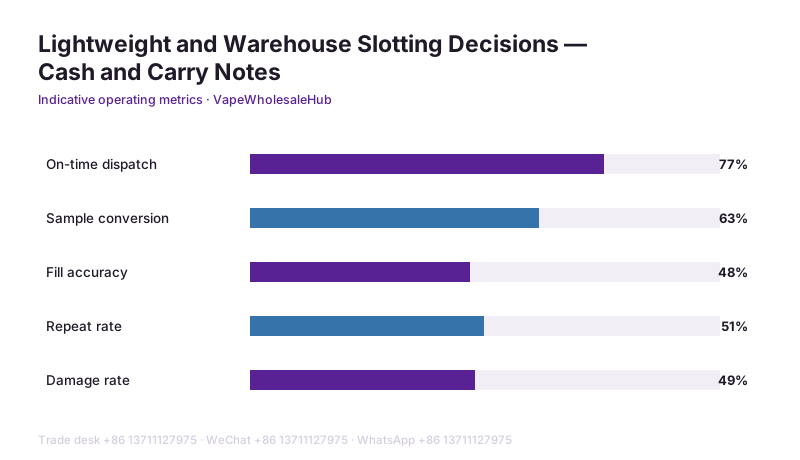
There is a version of lightweight and Warehouse Slotting Decisions — Cash and Carry Notes that exists in supplier decks, and there is the version that shows up on a warehouse floor at 7am when a shipment is short by two cartons. We spend our time in the second version. Below is what we have learned handling lightweight and Warehouse Slotting Decisions — Cash and Carry Notes for wholesale accounts.
What quality control looks like in practice
A quality system for lightweight and Warehouse Slotting Decisions — Cash and Carry Notes should produce a number someone is accountable for. Defect rate per batch, days to resolution, repeat complaint rate. Without a number, quality becomes an opinion, and opinions do not survive a busy quarter.
Quality control on lightweight and Warehouse Slotting Decisions — Cash and Carry Notes is unglamorous and repetitive, which is exactly why it works. Incoming inspection, fill weight checks, leak testing and a retained sample from every batch. None of this is clever; all of it is cheaper than a recall.
Technical detail worth understanding
Technically, lightweight and Warehouse Slotting Decisions — Cash and Carry Notes is a set of tolerances rather than a single specification. Coil resistance varies, battery capacity degrades, and perception shifts with device temperature. Designing within those tolerances is what separates a product that works from one that works in the lab.
Specification drift is the quiet risk in lightweight and Warehouse Slotting Decisions — Cash and Carry Notes. A unit approved in January is not necessarily the unit shipped in September unless the change control is tight. We document every revision, and we tell accounts before the change rather than after someone notices.
Where the supply actually comes from
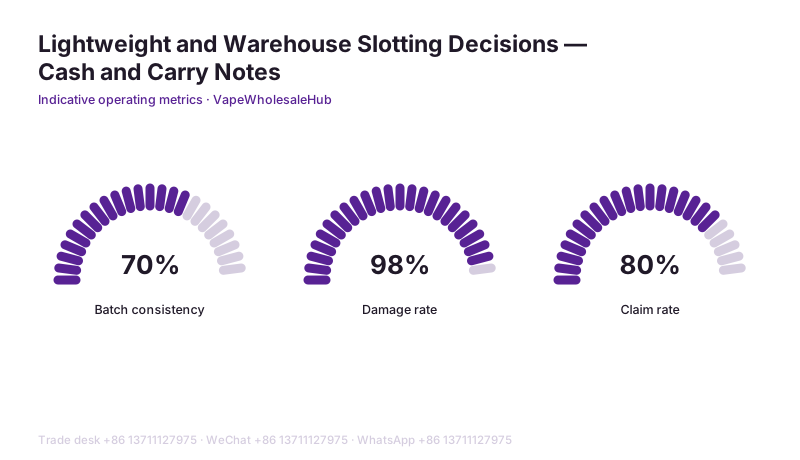
Sourcing decisions around lightweight and Warehouse Slotting Decisions — Cash and Carry Notes are usually made on price and then regretted on consistency. The input changes, the tolerance drifts, and suddenly the line that sold through in March behaves differently in July. Locking the input specification in writing is the cheapest insurance a wholesale buyer can buy.
A useful test for lightweight and Warehouse Slotting Decisions — Cash and Carry Notes is to ask two suppliers the same uncomfortable question and compare how long the answer takes. Serious operations have the data ready. Everyone else needs to check with someone, and that delay tells you how the next twelve months will feel.
Documentation and regulatory reality
The compliance burden around lightweight and Warehouse Slotting Decisions — Cash and Carry Notes is mostly about being boring and consistent. Keep one version of the truth for every SKU, stamp the revision date, and make sure the file a regulator sees is the same one your warehouse picks from. Most enforcement cases we have watched started with a mismatch between two internal documents.
Buyers sometimes treat compliance for lightweight and Warehouse Slotting Decisions — Cash and Carry Notes as a cost to be minimised. It reads better as a moat. When the market tightens, the accounts that already hold complete technical files keep trading while everyone else scrambles to produce paperwork that should have existed a year earlier.
Order structure at a glance
| Item | Standard | Volume | Programme |
|---|---|---|---|
| Typical order unit | Master carton | Pallet | Full container |
| Documentation | COA + SDS | COA + SDS + batch record | Full technical file |
| Lead time | 2-4 working days | 5-10 working days | 15-25 working days |
| Customisation | Label only | Label + closure + bottle | Full OEM / ODM |
| Sampling | Charged, credited on order | Included in development | Multi-round approval |
| Indicative MOQ | 1200 units | 6,000 units | 24,000 units |
| Development window | n/a | 3-5 working days | 3-5 + approval |
Common questions
Is there a warranty on hardware?
Hardware carries a limited warranty against manufacturing defects, covering dead on arrival and early failure within the stated period. Consumable parts such as coils and pods are excluded, as their life depends on how the end user treats them.
Which payment methods do you accept?
We accept bank wire transfer for most wholesale accounts, with card and digital payment options available for samples and smaller orders. Established accounts can apply for credit terms after a trading history has been established.
What happens if goods arrive damaged?
Photograph the cartons before unpacking, keep the packaging, and send the batch code with your claim. We settle legitimate freight damage as a credit or replacement on the following order rather than leaving it open for months.
Related reading
- Lightweight and component wear: A Cost Perspective — Scaling Up
- Planning Lightweight Promotions With Retailers — Independent Shop Notes
- Lightweight and Regulatory Paperwork: What Changes — Regional Depot Guide
- Lightweight: How to Read the Fine Print — Scaling Up
- Lightweight: Balancing Price Against storage conditions — Cash and Carry Notes
- Why Lightweight Matters in transport resilience — Wholesale Programme Notes
Talk to the wholesale desk. Specifications, MOQ, stock and freight options for lightweight and Warehouse Slotting Decisions — Cash and Carry Notes.
Phone +86 13711127975 · WeChat +86 13711127975 · WhatsApp +86 13711127975