Lightweight and component wear: A Cost Perspective — Scaling Up
VapeWholesaleHub Lightweight · Lightweight hardware build
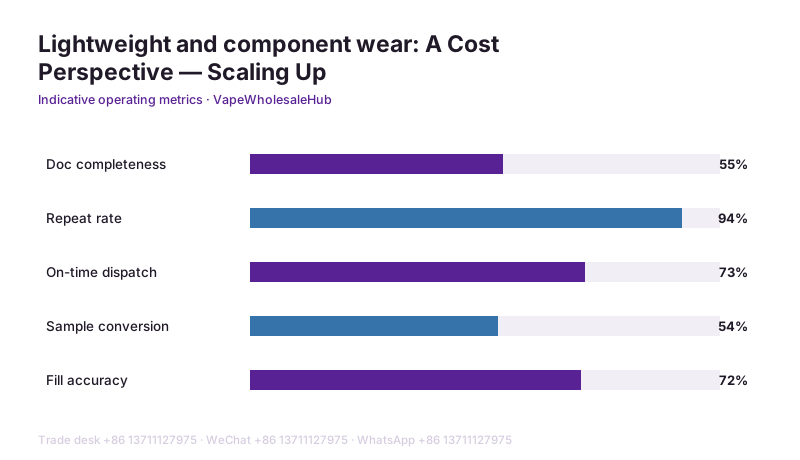
Distributors working with Lightweight rarely lose money on a single bad order. They lose it on the slow leaks: a spec sheet nobody read, a pallet held at customs for nine days, a line that quietly fell out of favour while the reorder was still on the water. This page looks at lightweight and component wear: A Cost Perspective — Scaling Up from the angle that matters to a buyer, not a brochure.
Documentation and regulatory reality
The compliance burden around lightweight and component wear: A Cost Perspective — Scaling Up is mostly about being boring and consistent. Keep one version of the truth for every SKU, stamp the revision date, and make sure the file a regulator sees is the same one your warehouse picks from. Most enforcement cases we have watched started with a mismatch between two internal documents.
Buyers sometimes treat compliance for lightweight and component wear: A Cost Perspective — Scaling Up as a cost to be minimised. It reads better as a moat. When the market tightens, the accounts that already hold complete technical files keep trading while everyone else scrambles to produce paperwork that should have existed a year earlier.
Technical detail worth understanding
The engineering around lightweight and component wear: A Cost Perspective — Scaling Up is mostly about managing heat and airflow. Change either and the whole experience moves. Buyers who understand that relationship can read a spec sheet properly and spot the marketing numbers that do not survive contact with a customer.
Technically, lightweight and component wear: A Cost Perspective — Scaling Up is a set of tolerances rather than a single specification. Coil resistance varies, battery capacity degrades, and perception shifts with device temperature. Designing within those tolerances is what separates a product that works from one that works in the lab.
What quality control looks like in practice
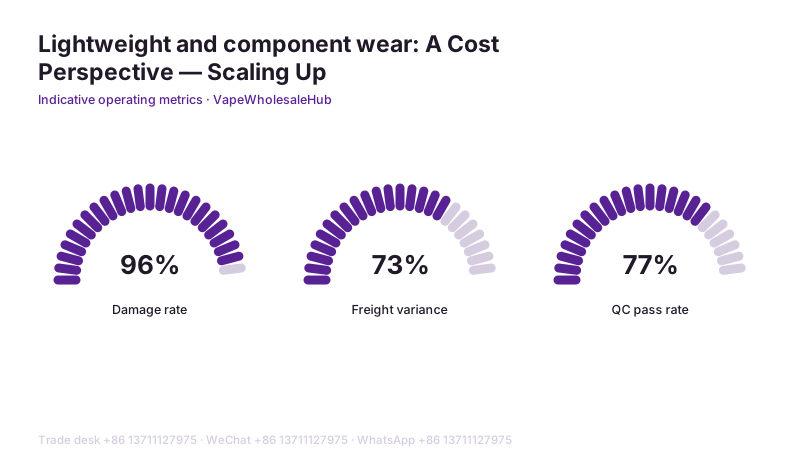
Quality control on lightweight and component wear: A Cost Perspective — Scaling Up is unglamorous and repetitive, which is exactly why it works. Incoming inspection, fill weight checks, leak testing and a retained sample from every batch. None of this is clever; all of it is cheaper than a recall.
The failure modes in lightweight and component wear: A Cost Perspective — Scaling Up are predictable once you have seen enough of them. Seals that relax in heat, tolerances that drift after a tooling change, inputs that separate in transit. Testing for the known failure modes catches roughly ninety percent of what would otherwise reach a customer.
Freight, packaging and landed cost
Logistics decides whether lightweight and component wear: A Cost Perspective — Scaling Up is profitable more often than product quality does. A three day saving on a freight route is worth more per unit than most price negotiations, and it is usually easier to achieve. Mode choice, consolidation and customs pre-clearance are where the margin actually lives.
Freight for lightweight and component wear: A Cost Perspective — Scaling Up has its own rhythm. Peak season rates, holiday closures and carrier capacity all move the landed cost in ways that a unit price sheet never shows. We plan replenishment backwards from the shelf date rather than forwards from the order date, and it removes most of the surprises.
Order structure at a glance
| Item | Standard | Volume | Programme |
|---|---|---|---|
| Typical order unit | Master carton | Pallet | Full container |
| Documentation | COA + SDS | COA + SDS + batch record | Full technical file |
| Lead time | 2-4 working days | 5-10 working days | 15-25 working days |
| Customisation | Label only | Label + closure + bottle | Full OEM / ODM |
| Sampling | Charged, credited on order | Included in development | Multi-round approval |
| Indicative MOQ | 1200 units | 6,000 units | 24,000 units |
| Development window | n/a | 10-15 working days | 10-15 + approval |
Common questions
What is the usual minimum order quantity?
Minimum order quantity depends on the line. Standard stock items typically start at a single master carton, while custom work, private label artwork and bespoke tooling carry higher thresholds because the setup cost has to be recovered. We publish the figure for each line rather than quoting one blanket number.
How are samples handled?
Sample packs are charged at cost with the shipping borne by the buyer, and the amount is credited against your first bulk order. That keeps sampling serious and avoids the delays that come with an open-ended free sample programme.
Is there a warranty on hardware?
Hardware carries a limited warranty against manufacturing defects, covering dead on arrival and early failure within the stated period. Consumable parts such as coils and pods are excluded, as their life depends on how the end user treats them.
Related reading
- Lightweight: Packaging Options and Trade Offs — Franchise Network Guide
- How Lightweight Influences Purchase Frequency — High Volume Planning
- Lightweight Vape Supply Notes 917
- Reading a Lightweight Specification Sheet — Contract Supply Guide
- Lightweight Vape Supply Notes 729
- Lightweight Vape Supply: Freight and Packaging Notes — Multi Site Operations
Talk to the wholesale desk. Specifications, MOQ, stock and freight options for lightweight and component wear: A Cost Perspective — Scaling Up.
Phone +86 13711127975 · WeChat +86 13711127975 · WhatsApp +86 13711127975