Lightweight: Balancing Price Against user handling — Export Market Guide
VapeWholesaleHub Lightweight · Lightweight hardware build
Most conversations about lightweight: Balancing Price Against user handling — Export Market Guide start in the wrong place. Someone asks for a price per unit before anyone has agreed what the unit actually is. This page works through the subject the way a purchasing desk experiences it, from the first sample request to the container arriving at the dock.
Where the supply actually comes from
Sourcing decisions around lightweight: Balancing Price Against user handling — Export Market Guide are usually made on price and then regretted on consistency. The input changes, the tolerance drifts, and suddenly the line that sold through in March behaves differently in July. Locking the input specification in writing is the cheapest insurance a wholesale buyer can buy.
A useful test for lightweight: Balancing Price Against user handling — Export Market Guide is to ask two suppliers the same uncomfortable question and compare how long the answer takes. Serious operations have the data ready. Everyone else needs to check with someone, and that delay tells you how the next twelve months will feel.
What quality control looks like in practice
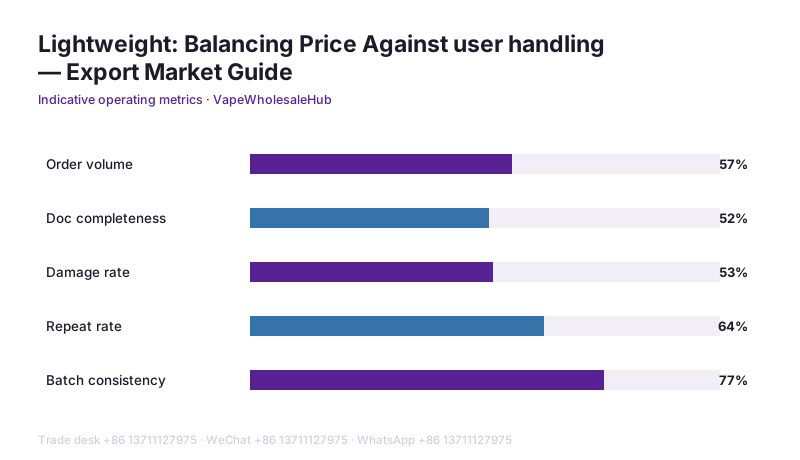
A quality system for lightweight: Balancing Price Against user handling — Export Market Guide should produce a number someone is accountable for. Defect rate per batch, days to resolution, repeat complaint rate. Without a number, quality becomes an opinion, and opinions do not survive a busy quarter.
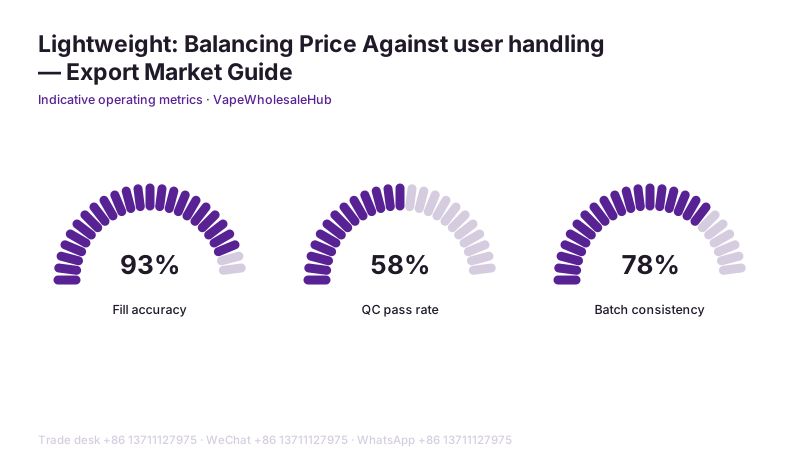
The failure modes in lightweight: Balancing Price Against user handling — Export Market Guide are predictable once you have seen enough of them. Seals that relax in heat, tolerances that drift after a tooling change, inputs that separate in transit. Testing for the known failure modes catches roughly ninety percent of what would otherwise reach a customer.
Documentation and regulatory reality
Compliance is where lightweight: Balancing Price Against user handling — Export Market Guide either holds together or quietly falls apart. Regulators are not interested in intent; they want documents that match the physical goods. If the label says one thing and the test report says another, the shipment is the problem, not the paperwork.
The compliance burden around lightweight: Balancing Price Against user handling — Export Market Guide is mostly about being boring and consistent. Keep one version of the truth for every SKU, stamp the revision date, and make sure the file a regulator sees is the same one your warehouse picks from. Most enforcement cases we have watched started with a mismatch between two internal documents.
The commercial side of the decision
Commercially, lightweight: Balancing Price Against user handling — Export Market Guide rewards buyers who think in turns rather than in unit cost. A slightly higher price on a line that sells through twice as fast is better money than a cheap line that occupies shelf space and working capital for two seasons.
The accounts that grow steadily on lightweight: Balancing Price Against user handling — Export Market Guide tend to do one boring thing well: they reorder before they run out. It sounds obvious. In practice, most wholesale buyers reorder late, pay for expedited freight, and then blame the supplier for the cost.
Order structure at a glance
| Item | Standard | Volume | Programme |
|---|---|---|---|
| Typical order unit | Master carton | Pallet | Full container |
| Documentation | COA + SDS | COA + SDS + batch record | Full technical file |
| Lead time | 2-4 working days | 5-10 working days | 15-25 working days |
| Customisation | Label only | Label + closure + bottle | Full OEM / ODM |
| Sampling | Charged, credited on order | Included in development | Multi-round approval |
| Indicative MOQ | 500 units | 2,500 units | 10,000 units |
| Development window | n/a | 5-8 working days | 5-8 + approval |
Common questions
How are samples handled?
Sample packs are charged at cost with the shipping borne by the buyer, and the amount is credited against your first bulk order. That keeps sampling serious and avoids the delays that come with an open-ended free sample programme.
Is there a warranty on hardware?
Hardware carries a limited warranty against manufacturing defects, covering dead on arrival and early failure within the stated period. Consumable parts such as coils and pods are excluded, as their life depends on how the end user treats them.
What happens if goods arrive damaged?
Photograph the cartons before unpacking, keep the packaging, and send the batch code with your claim. We settle legitimate freight damage as a credit or replacement on the following order rather than leaving it open for months.
Related reading
- Lightweight and tolerance control: A Cost Perspective — Cash and Carry Notes
- Allocating Marketing Support for Lightweight — Export Market Guide
- Lightweight Orders and Batch Traceability — Bulk Order Planning
- Lightweight: Balancing Price Against tolerance control — Trade Buyer Briefing
- Lightweight and component wear: Notes From the Trade Desk — Distributor Focus
- Approved Supplier Lists and Lightweight — Scaling Up
Talk to the wholesale desk. Specifications, MOQ, stock and freight options for lightweight: Balancing Price Against user handling — Export Market Guide.
Phone +86 13711127975 · WeChat +86 13711127975 · WhatsApp +86 13711127975