Lightweight: Balancing Price Against storage conditions — High Volume Planning
VapeWholesaleHub Lightweight · Lightweight hardware build
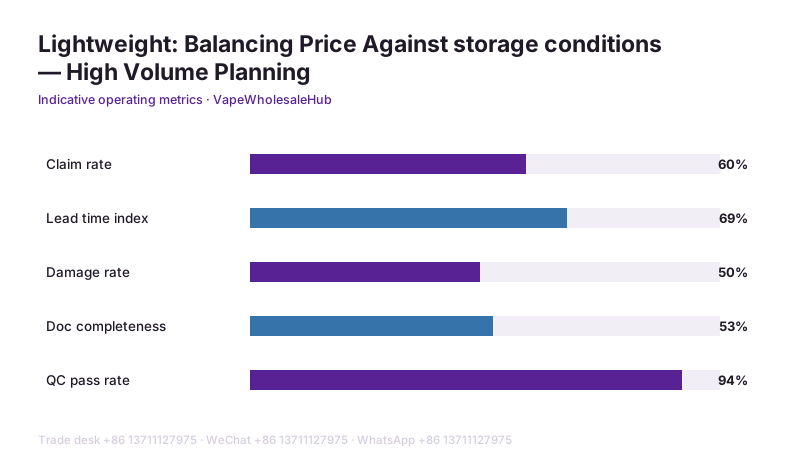
Most conversations about lightweight: Balancing Price Against storage conditions — High Volume Planning start in the wrong place. Someone asks for a price per unit before anyone has agreed what the unit actually is. This page works through the subject the way a purchasing desk experiences it, from the first sample request to the container arriving at the dock.
The commercial side of the decision
Commercially, lightweight: Balancing Price Against storage conditions — High Volume Planning rewards buyers who think in turns rather than in unit cost. A slightly higher price on a line that sells through twice as fast is better money than a cheap line that occupies shelf space and working capital for two seasons.
Margin on lightweight: Balancing Price Against storage conditions — High Volume Planning is usually set by the structure of the deal, not the sticker. Payment terms, freight responsibility, breakage allowance and return rights all move the real number. We would rather agree a clean structure with a fair price than a low price with vague terms that get argued about later.
Freight, packaging and landed cost
Packaging is part of logistics, not marketing. Cartons for lightweight: Balancing Price Against storage conditions — High Volume Planning need to survive stacking, humidity and a forklift operator having a bad Monday. We specify board grade and pallet pattern before we talk about print finish, because a damaged pallet costs more than any artwork upgrade recovers.
Freight for lightweight: Balancing Price Against storage conditions — High Volume Planning has its own rhythm. Peak season rates, holiday closures and carrier capacity all move the landed cost in ways that a unit price sheet never shows. We plan replenishment backwards from the shelf date rather than forwards from the order date, and it removes most of the surprises.
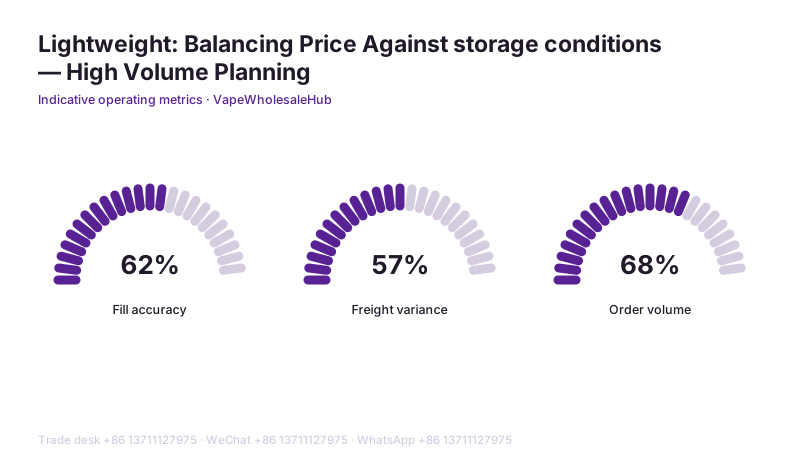
Where the supply actually comes from
Sourcing decisions around lightweight: Balancing Price Against storage conditions — High Volume Planning are usually made on price and then regretted on consistency. The input changes, the tolerance drifts, and suddenly the line that sold through in March behaves differently in July. Locking the input specification in writing is the cheapest insurance a wholesale buyer can buy.
On the sourcing side, lightweight: Balancing Price Against storage conditions — High Volume Planning comes down to how much of the chain you can see. A trading desk that only ever talks to a sales rep is buying on faith. We prefer accounts that ask for the factory audit, the mixing records and the batch numbers, because that paperwork is what protects everyone when a shipment is questioned later.
Documentation and regulatory reality
Buyers sometimes treat compliance for lightweight: Balancing Price Against storage conditions — High Volume Planning as a cost to be minimised. It reads better as a moat. When the market tightens, the accounts that already hold complete technical files keep trading while everyone else scrambles to produce paperwork that should have existed a year earlier.
Compliance is where lightweight: Balancing Price Against storage conditions — High Volume Planning either holds together or quietly falls apart. Regulators are not interested in intent; they want documents that match the physical goods. If the label says one thing and the test report says another, the shipment is the problem, not the paperwork.
Order structure at a glance
| Item | Standard | Volume | Programme |
|---|---|---|---|
| Typical order unit | Master carton | Pallet | Full container |
| Documentation | COA + SDS | COA + SDS + batch record | Full technical file |
| Lead time | 2-4 working days | 5-10 working days | 15-25 working days |
| Customisation | Label only | Label + closure + bottle | Full OEM / ODM |
| Sampling | Charged, credited on order | Included in development | Multi-round approval |
| Indicative MOQ | 1200 units | 6,000 units | 24,000 units |
| Development window | n/a | 3-5 working days | 3-5 + approval |
Common questions
Which payment methods do you accept?
We accept bank wire transfer for most wholesale accounts, with card and digital payment options available for samples and smaller orders. Established accounts can apply for credit terms after a trading history has been established.
Do you ship internationally?
We ship to most markets where the import of these products is permitted. Some destinations restrict nicotine containing goods entirely, and a few require additional registration before clearance. We will tell you honestly if a route is not workable before you pay.
What happens if goods arrive damaged?
Photograph the cartons before unpacking, keep the packaging, and send the batch code with your claim. We settle legitimate freight damage as a credit or replacement on the following order rather than leaving it open for months.
Related reading
- Lightweight and Shelf Life: Storage Guidance — Online Reseller Notes
- How Lightweight Programmes Affect Your drop testing — Retail Chain Focus
- Managing user handling Across Lightweight Product Lines — New Account Setup
- Lightweight and Supplier Communication Cadence — Cash and Carry Notes
- Lightweight Vape Supply Notes 167
- Lightweight Vape Supply Notes 301
Talk to the wholesale desk. Specifications, MOQ, stock and freight options for lightweight: Balancing Price Against storage conditions — High Volume Planning.
Phone +86 13711127975 · WeChat +86 13711127975 · WhatsApp +86 13711127975