Lightweight and field failure rates in Contract Supply — Wholesale Programme Notes
VapeWholesaleHub Lightweight · Lightweight hardware build
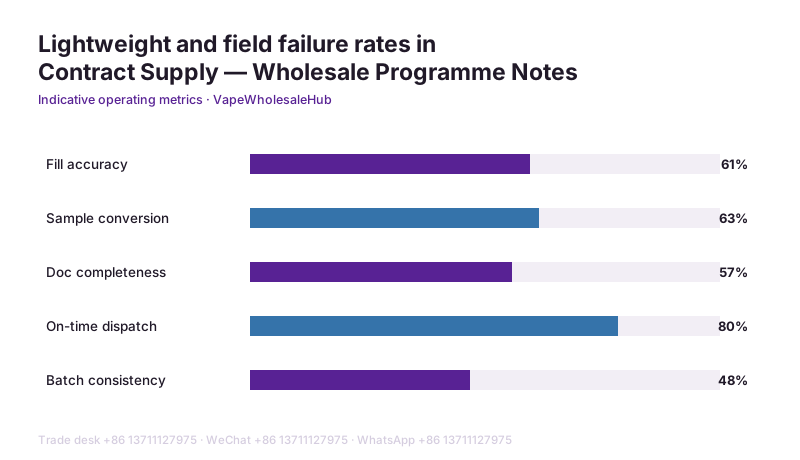
Most conversations about lightweight and field failure rates in Contract Supply — Wholesale Programme Notes start in the wrong place. Someone asks for a price per unit before anyone has agreed what the unit actually is. This page works through the subject the way a purchasing desk experiences it, from the first sample request to the container arriving at the dock.
Technical detail worth understanding
The engineering around lightweight and field failure rates in Contract Supply — Wholesale Programme Notes is mostly about managing heat and airflow. Change either and the whole experience moves. Buyers who understand that relationship can read a spec sheet properly and spot the marketing numbers that do not survive contact with a customer.
Specification drift is the quiet risk in lightweight and field failure rates in Contract Supply — Wholesale Programme Notes. A unit approved in January is not necessarily the unit shipped in September unless the change control is tight. We document every revision, and we tell accounts before the change rather than after someone notices.
Freight, packaging and landed cost
Freight for lightweight and field failure rates in Contract Supply — Wholesale Programme Notes has its own rhythm. Peak season rates, holiday closures and carrier capacity all move the landed cost in ways that a unit price sheet never shows. We plan replenishment backwards from the shelf date rather than forwards from the order date, and it removes most of the surprises.
Packaging is part of logistics, not marketing. Cartons for lightweight and field failure rates in Contract Supply — Wholesale Programme Notes need to survive stacking, humidity and a forklift operator having a bad Monday. We specify board grade and pallet pattern before we talk about print finish, because a damaged pallet costs more than any artwork upgrade recovers.
What quality control looks like in practice
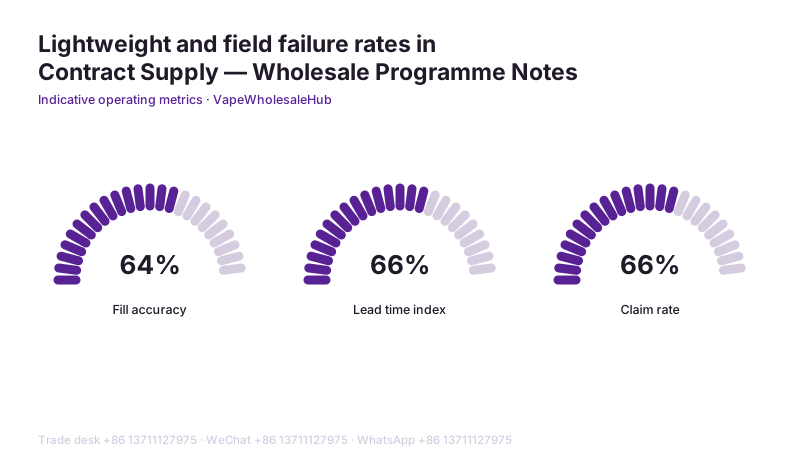
A quality system for lightweight and field failure rates in Contract Supply — Wholesale Programme Notes should produce a number someone is accountable for. Defect rate per batch, days to resolution, repeat complaint rate. Without a number, quality becomes an opinion, and opinions do not survive a busy quarter.
The failure modes in lightweight and field failure rates in Contract Supply — Wholesale Programme Notes are predictable once you have seen enough of them. Seals that relax in heat, tolerances that drift after a tooling change, inputs that separate in transit. Testing for the known failure modes catches roughly ninety percent of what would otherwise reach a customer.
Documentation and regulatory reality
Compliance is where lightweight and field failure rates in Contract Supply — Wholesale Programme Notes either holds together or quietly falls apart. Regulators are not interested in intent; they want documents that match the physical goods. If the label says one thing and the test report says another, the shipment is the problem, not the paperwork.
Buyers sometimes treat compliance for lightweight and field failure rates in Contract Supply — Wholesale Programme Notes as a cost to be minimised. It reads better as a moat. When the market tightens, the accounts that already hold complete technical files keep trading while everyone else scrambles to produce paperwork that should have existed a year earlier.
Order structure at a glance
| Item | Standard | Volume | Programme |
|---|---|---|---|
| Typical order unit | Master carton | Pallet | Full container |
| Documentation | COA + SDS | COA + SDS + batch record | Full technical file |
| Lead time | 2-4 working days | 5-10 working days | 15-25 working days |
| Customisation | Label only | Label + closure + bottle | Full OEM / ODM |
| Sampling | Charged, credited on order | Included in development | Multi-round approval |
| Indicative MOQ | 1200 units | 6,000 units | 24,000 units |
| Development window | n/a | 10-15 working days | 10-15 + approval |
Common questions
Which payment methods do you accept?
We accept bank wire transfer for most wholesale accounts, with card and digital payment options available for samples and smaller orders. Established accounts can apply for credit terms after a trading history has been established.
Can you supply documentation for our regulator?
Yes. Technical files, certificates of analysis, safety data sheets and batch records are provided with shipments on request. Tell us which national scheme you operate under at the enquiry stage and we will confirm exactly which documents come as standard.
What shelf life should we plan around?
Unopened e-liquid is typically stable for around two years when stored cool and away from direct light, and device batteries lose capacity on a similar curve. We print manufacture dates and batch codes on every unit so stock rotation is straightforward.
Related reading
- How Lightweight Affects Working Capital — Bulk Order Planning
- Understanding tolerance control in Lightweight Wholesale — Cash and Carry Notes
- Buyer Checklist for Lightweight Vape Programmes — High Volume Planning
- Lightweight Vape Supply Notes 846
- Lightweight Vape Supply Notes 68
- Managing material selection Across Lightweight Product Lines — Contract Supply Guide
Talk to the wholesale desk. Specifications, MOQ, stock and freight options for lightweight and field failure rates in Contract Supply — Wholesale Programme Notes.
Phone +86 13711127975 · WeChat +86 13711127975 · WhatsApp +86 13711127975